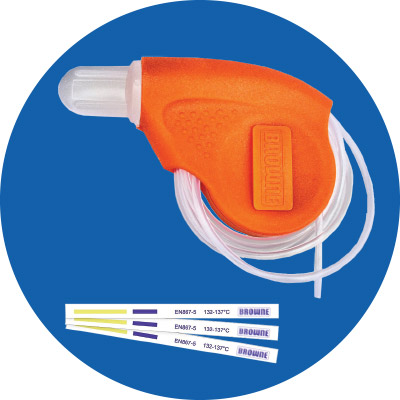
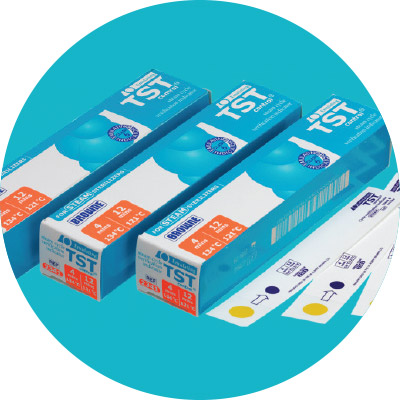
Albert Browne Chemical Indicators & Accessories
Browne products are designed to be an integral part of the different stages of a decontamination process cleaning, disinfection and sterilisation and are available for almost all types of processes.
What are Chemical Indicators
Perhaps the simplest analogy for a chemical indicator is one found in nature; if planted in alkaline soil, the blooms of a hydrangea will be pink; conversely, if planted in acid soil, the blooms will be blue. So by way of a simple display of colour, the hydrangea is providing information about its’ immediate environment; it is indicating the pH of its’ surrounding soil.
This is a very simplistic analogy and of course the Browne range of chemical indicators provides much more information than an indication of surrounding pH.
There are similarities however, as they do provide information about their immediate surrounding by way of an easily interpreted colour change.
The Six Indicator Types
The Browne range of chemical indicators have been categorised into six areas, broadly defined by intended use. These are colour-coded for easy indentification:

Process Indicator
Browne Process Indicators are usually placed on the outside of the tray, pack or pouch so that processed and unprocessed items can be identified at a glance. They give users assurance that the tray, pack or pouch has been exposed to a particular process, e.g. steam, ethylene oxide etc. but cannot provide quantitative information about the process or determine how effective it has been.
They are sometimes referred to as ‘exposure control’ or ‘through-put’ indicators.

Specific-Use Indicator
Browne specific-use indicators are designed for use in two fundamental areas; in specific test procedures defined in relevant standards and guidance documents and in monitoring defined stages of a process that would otherwise be difficult to routinely assess.
Mechanical equipment used throughout the decontamination process will have undergone validation before being sanctioned for daily use. Most machines equipped with electronic or mechanical sensors to record specific aspects of the machines activity.
These sensors are connected to monitoring and recording gauges, graphical charts and digital displays that provide fundamental information on the machine.s performance. Although providing vital information on the machine.s mechanical activity, they cannot provide monitoring of the physical conditions occurring inside the chamber of the machine. Furthermore, between scheduled maintenance visits, these sensors, monitors and recorders can lose calibration.
Browne specific-use indicators can help resolve these two issues by providing supplementary data on critical aspects and/or during stages of a process.

Multi-Parameter Indicator
Browne Multi-Parameter Indicators are the first of three types of indicator available for ‘in-pack’ monitoring and like the others are placed inside each tray, pack or pouch before processing.
These indicators will change colour when exposed to the sterilant and/or disinfectant providing users with clear visual reassurance that the agent has penetrated to the point of placement in each tray, pack or pouch.

Integrating Indicator
Browne Integrating Indicators are the second of three types of indicator available for .in-pack. monitoring and like the others are placed inside each tray, pack or pouch before processing.
The indicators will change colour when exposed to a sterilant and/or disinfectant in sufficient quantity or duration to inactivate the equivalent challenge presented by a defined and stated test organism. This provides users with clear visual reassurance that the agent has penetrated to the point of placement in each tray, pack or pouch.

Cycle Verification Indicator
Browne Cycle Verification (Emulating) Indicators are the third of three types of indicator available for ‘in-pack’ monitoring.
Cycle Verification Indicators provide the most specific information of any chemical indicator available and like the others are placed inside each tray, pack or pouch before processing.
The primary difference between these and other chemical indicators is their cycle specificity. All conform to the ISO 11140-1 classification as Class 6 indicators, which means that each product will have been calibrated to perform to the predefined parameters of a particular process. The use of a Cycle Verification Indicator will help end-users detect process failure by confirming that all of the predetermined cycle parameters have occurred at point of placement in each tray, pack or pouch. This is demonstrated through an easy to interpret colour change.

Biological Indicator
Browne Biological Indicators have two main areas of use; firstly, where regulatory authorities and guidance documents require the use of a biological indicator in a specified decontamination process. These usually include Ethylene Oxide, Plasma and Low Temperature Steam with Formaldehyde. And secondly, during a machine validation process where cycle variables need to be defined and established.
All conform to ISO 11138 and are supplied with a certificate containing the culture collection number, lot number, expiry date, spore population, resistance data and Biological Indicator Evaluation Resistometer (BIER) exposure.